One of the most significant aspects of business management is bookkeeping. It assists you in tracking income, controlling expenses, and managing cash flow and also keeping in check with the tax laws. In 2026, enterprises will be fast and online with digital surroundings where financial transparency is key to expansion.
The question that remains on the minds of many business owners is:
Should I continue with manual bookkeeping or switch to automated bookkeeping?
Let us understand both methods properly and compare them clearly.
What Is Manual Bookkeeping?
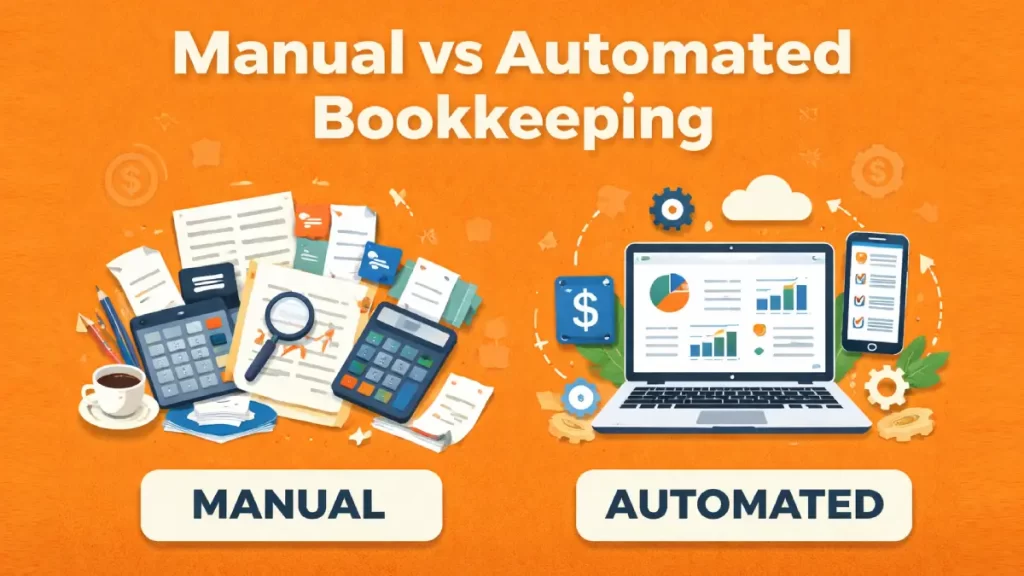
Manual bookkeeping is the old fashioned approach of keeping records of financial transactions manually. Owners of business keep physical sheets or spreadsheets to take note of sales, purchases, expenditure and payments.
All the calculations, reconciliations as well as financial reports are done manually. This is a technique that has full control of entries though it takes time, patience, and attention to details. Very small businesses that have minimal transactions and operations tend to prefer manual bookkeeping.
What Is Automated Bookkeeping?
Automated bookkeeping involves the accounting software in which financial records are handled. Bank accounts, payment gateways, or billing system transactions are automatically imported. The software organizes the entries, monitors the costs, and produces reports immediately.
In 2026, the majority of modern systems are cloud based and thus financial data can be viewed anywhere and is also kept safely. Electronic record keeping saves time and offers real-time financial information.
Quick Comparison: Manual vs Automated Bookkeeping
| Comparison Factor | Manual Bookkeeping | Automated Bookkeeping |
| Initial Setup | Simple notebooks or spreadsheets | Requires accounting software setup |
| Time Requirement | High time investment | Saves significant time |
| Real-Time Tracking | Not available | Available instantly |
| Report Generation | Prepared manually | Auto-generated within seconds |
| Scalability | Difficult with growing transactions | Easily handles business growth |
| Data Backup | Physical storage, risk of loss | Cloud backup with secure storage |
| Compliance Support | Manual tax calculations | Built-in GST and tax features |
| Remote Access | Limited to physical records | Accessible from anywhere |
| Decision Support | Delayed financial visibility | Instant financial insights |
| Long-Term Efficiency | Becomes complex as business expands | Improves efficiency over time |
Accuracy and Reliability
With manual bookkeeping, all data entry is done manually. Financial reports and totals can be impacted even by a minor typing error or skipped transaction. It can be time consuming and difficult to detect and correct these errors once they have been made.
Automated bookkeeping is a way to minimize these risks by calculating and structuring the entries automatically. A lot of systems also show unusual transactions to be reviewed. Even though it still requires human supervision, automation can in many ways enhance the general accuracy and reliability of financial management.
Cost Considerations in 2026
Manual bookkeeping can seem cheaper due to the lack of subscription fees. However, hidden costs exist. The amount of time used in record keeping, fixing mistakes, and report production raises operational workload. With the expansion of the business, it might be required to seek the assistance of professional accountants.
Bookkeeping is automated and is charged a subscription fee. Nonetheless, it lowers the manual work, eliminates the high-priced errors, and enhances productivity. In the case of businesses that are growing, the payoff of the investment in the long run is mostly greater.
Impact on Business Growth
Small volumes of transactions can be effectively handled using manual bookkeeping but as a business grows larger the data to be managed in the manual way will be tedious and difficult. It might also take extra work to prepare detailed reports to investors, loans or audits.
Designated bookkeeping is supposed to facilitate expansion. It manages growing transactions with ease, can create structured financial reports instantly and give a better look at cash flow and performance. In 2026, companies seeking to expand need to take into account the quality of the bookkeeping system on scalability and long-term growth.
Security and Data Protection
Manual bookkeeping records are stored in physical registers or local spreadsheets, which can be destroyed, lost, stolen or accidentally deleted. Recovery is also not always an easy task and it depends upon the safety in which the documents are kept.
The automation of bookkeeping keeps the information of finances in safe cloud servers with encryptions and password-protected databases and automatic backup. In case of a device breakdown, data can still be accessed online. Financial safety and compliance require selecting a system that ensures high-quality data protection in 2026.
Which One Should You Choose in 2026?
The decision to be made will depend on your business size, volume of transactions, budget and your future strategies. Manual bookkeeping can be effective with very small businesses that have few transactions and do not require a complicated financial system. It provides control and low set up requirements.
On the one hand, automated bookkeeping helps to process faster, track in real time, and manage compliance more easily, which can have a positive impact on the development of businesses. Both approaches are still applicable in various contexts in 2026.
Rather than going by a trend, assess your level of complexity in operations, expansion objectives and technological comfort. The most appropriate bookkeeping system should be the one that meets your immediate requirements without confusing your future sustainability.